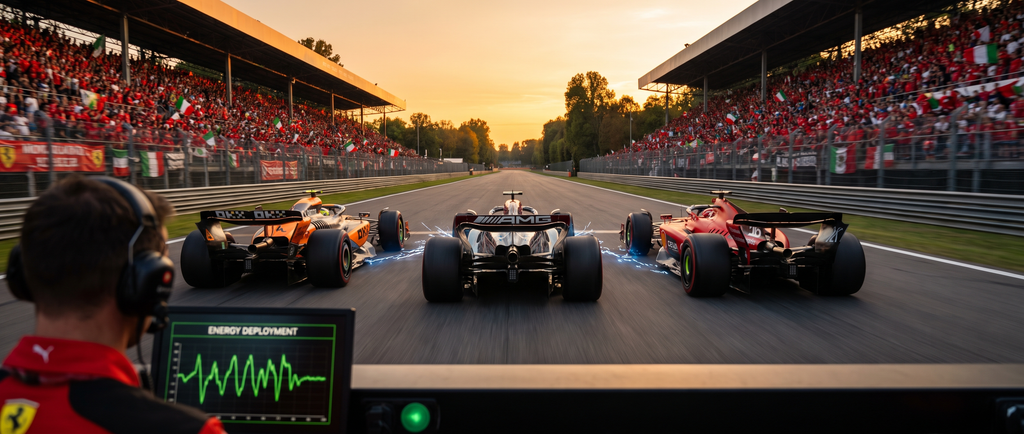
After two races shaped by car performance on twisty circuits, Formula 1 heads to Monza. The Temple of Speed will put power unit efficiency, active aerodynamics and energy management across 53 laps under a brighter spotlight.
The 2026 rule changes the way Monza is read
The 2026 power units give electricity a much larger role. Around half of the power used by the car now comes from the electrical side and half from the combustion engine. Available energy must first be recovered and then deployed at the right moment.
The FIA and Formula 1 describe this as a major change to hybrid technology. At Monza, the question will be especially visible. Long full throttle phases demand energy, while braking is concentrated in a few chicanes. Drivers and teams must therefore choose between an immediate attack and a reserve for the end of the lap.
A twisty circuit offers more frequent braking and more chances to recover energy. Monza concentrates acceleration and heavy braking. Recharge, Boost and the new Overtake Mode become racing tools, not just background settings.
Two circuit profiles, two strategies
The comparison with Hungary and Zandvoort needs to remain cautious. Those tracks demand different downforce levels and tyre management. A team that is strong in slow corners will not automatically be fastest on Monza’s long straights.
The most efficient car will lose the least speed on the straights without sacrificing braking stability. Active aerodynamics can reduce drag in the fast sectors, but its operation must remain consistent with recharge phases and braking zones.
Top speed gaps will not tell the whole story. Watch repeatable performance, brake temperatures and the ability to save energy for attacks and defence in the closing laps.
The teams to watch
Mercedes brings significant experience with its power unit and should be watched on a circuit that rewards high speed efficiency. That does not guarantee a win, because setup and tyre management remain decisive.
Ferrari has the special advantage of racing in front of the Tifosi, but crowd support cannot replace track efficiency. McLaren must show that its chassis strengths remain competitive when top speed and drag matter more. Red Bull can become the outsider if it uses braking and traction effectively.
What Monza can change in the championship
Monza will not provide a final answer on the 2026 order. It will offer valuable information about car versatility. Teams that can adapt downforce and energy strategy may gain an advantage before the final stretch of the season.
The race will also be decided in the pit lane and in traffic. A deployment profile that is too aggressive can leave a car exposed late in the race, while conservative management can cost positions on the straights. At Monza, repeated tenths quickly become several places.
Frequently asked questions
Why is energy so important at Monza?
The 2026 rules increase the role of the electrical side. Monza combines long full throttle sections with a few heavy braking zones, making recharge and deployment especially visible.
Does Monza host a Sprint in 2026?
No. The official 2026 calendar lists a standard Monza weekend from September 4 to 6. The season’s six Sprints take place at other circuits.
Which circuit figures are confirmed?
Formula 1 lists a 5.793 kilometre circuit, 53 laps and around 80% of the lap at full throttle. The start finish straight is 1.1 kilometres long.