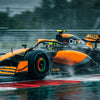
What is happening in Formula 1 today is no small matter. From June 1, 2026, the FIA is applying a new method for checking engine compression ratios: tests will now be carried out both cold and at 130°C, the real operating temperature of an F1 engine. The paddock has clearly identified the target. For months, Mercedes has been suspected of exploiting a thermal grey area to exceed the permitted 16:1 ratio, a loophole that may have contributed to Antonelli's dominance since the start of the season. And the first race under this new regime is Monaco. To dive into the world of this explosive season, check out our paddock-inspired pieces in our F1 2026 collection.
The rule that changes everything today
⚙️ Regulation change: Article C5.4.3
The maximum compression ratio of F1 engines is set at 16:1 (compared with 18:1 under the old regulations). Until today, this ratio was only checked at ambient temperature. From June 1, 2026, the check is carried out at both temperatures. In 2027, only the hot check (130°C) will remain.
Early 2026Cold check only
June 1, 2026 ★Cold + 130°C check
2027130°C check only
16:1
Maximum compression ratio allowed in 2026
130°C
Temperature of the new FIA check from tonight
2 months
Brought forward from the original schedule
The loophole: how Mercedes played with physics
To understand what we are talking about, we need to go back to the basics of thermodynamics. An engine's compression ratio is the ratio between the cylinder volume with the piston at the bottom of its stroke and at the top. The higher the ratio, the more powerful the engine. The FIA set the limit at 16:1 for 2026, compared with 18:1 under the old regulations, notably to attract new engine manufacturers and make the formula more accessible.
The problem: the regulations stated that this value had to be measured "at ambient temperature", meaning with the engine cold and stationary. But metals expand with heat. According to rivals' suspicions, Mercedes designed an engine architecture that cleverly exploits the properties of its materials to stay under 16:1 during cold checks, while reaching a noticeably higher ratio once the engine is at its real operating temperature.
The compression ratio of the Mercedes V6 exceeds 16:1. The FIA technical delegate in charge of power units, Vincent Pereme, declared the combustion chamber of the Mercedes engine compliant with the regulations, but after lengthy negotiations and serious embarrassment on the federation's side.
Motorsport.com, March 2026
Put simply: the Mercedes engine was legal when cold. But nobody knew what it became when hot. And that is precisely the grey area the new rule now closes.
Who is accusing, who is defending?
Mercedes
⚠️ In the crosshairs
Suspected of exploiting thermal expansion to exceed 16:1 in real conditions. Has stated that no engine modification will be necessary. Customers Alpine and Williams are also affected.
Red Bull Powertrains
⚠️ Possibly affected
Mentioned to a lesser extent in the initial accusations. Red Bull and Racing Bulls use this Ford engine. The situation is less clearly documented than for Mercedes.
Ferrari + Audi + Honda
✅ Leading the revolt
Have put constant pressure on the FIA since the off-season. Furious with Mercedes, according to Motorsport-Magazin. Called for a unanimous vote, which was secured, to change the regulations from June.
FIA
✅ Has ruled
After "lengthy negotiations and serious embarrassment", approved the change with the unanimous backing of the five engine manufacturers. Brought the entry into force forward by two months compared with the original August 1 schedule.
Mercedes customers also facing uncertainty
What makes this situation even more explosive is that Mercedes' supposed advantage does not only concern the Brackley team. Alpine, Williams and McLaren also use the Mercedes engine in 2026. If the thermal loophole really did deliver a power gain since the start of the season, these three teams have also benefited from it without knowing, or perhaps knowing full well.
This raises an immediate question: was McLaren's edge over Ferrari and Red Bull at the start of the season partly due to an illicit engine advantage? And what will happen in the coming weeks if Mercedes has to adapt its architecture?
Mercedes says it has nothing to change
Mercedes' official position is clear: according to the German manufacturer, no work on the engine will be needed to comply with the new rules. Something impossible to verify from the outside, which the paddock therefore greets with marked scepticism. Other sources believe Mercedes will have to modify the cylinder head, perhaps by adjusting the volume of the combustion chamber. A change that would take time and cost resources under the budget cap.
Monaco: the worst place to measure the impact
The irony of the situation is that Monaco is precisely the circuit least sensitive to engine power on the entire calendar. The streets of Monte-Carlo, with their slow corners, short straights and heavy braking zones, reward aerodynamics, mechanical balance and driver skill far more than an engine's extra horsepower.
In concrete terms: if Mercedes loses a few horsepower in Monaco, the impact on the race result will probably be minimal. The circuits where the effect will be most visible are: Barcelona (fast straights), Silverstone, Monza. That is where the real verdict will be delivered.
-
Monaco (June 7): Estimated impact very low. The circuit is too slow for engine power to be decisive. Leclerc remains the favourite from pole.
-
Barcelona (June 14): First real test of the impact. A long pit straight and several fast corners where power counts.
-
Silverstone (July): The high-speed circuit par excellence. If Mercedes has lost power, it will be measurable here.
-
Monza (September): The temple of speed. The final verdict on how much of an advantage Mercedes has lost.
Antonelli: a champion thanks to a loophole?
The question is inevitable and it will fuel debate until the end of the season. Did Kimi Antonelli's four consecutive wins since Melbourne rest partly on an engine advantage that should never have existed? The honest answer is: nobody really knows. The FIA itself has never officially quantified the gain linked to the thermal loophole, assuming it really exists.
Nikolas Tombazis, the FIA's single-seater director, had even said during the off-season that he did not think the subject deserved "such a level of attention". That did not stop the federation from changing the regulations two months earlier than planned.
The FIA has worked to find a compromise solution determining that the compression ratio will be checked under both hot and cold conditions from June 1, then only under normal operating conditions from 2027.
Official FIA statement, February 2026
What is certain: if the loophole had no impact, the FIA would not have brought its entry into force forward by two months. The fact that five engine manufacturers voted unanimously to change the regulations is a strong signal in itself. You do not change a rule in a hurry if the problem is cosmetic.
Monaco under new regulations, Antonelli in a new light
The 2026 season has just entered a new chapter. The FIA has ruled, the regulations change today, and Monaco will be the first race under this new regime. The real impact on the performance of Mercedes and Antonelli remains to be assessed: the Monte-Carlo circuit is not the ideal place to measure it. But the coming weeks in Barcelona, Silverstone and Monza will tell us everything. If Mercedes' advantage melts like snow in the sun, the paddock will have its answer. If Antonelli keeps dominating, then the loophole may have been nothing more than a paddock rumour amplified by rivals' jealousy. Either way, F1 2026 has just become even more interesting. Find all the passion of Formula 1 at Tourismo Clothing.
The loophole is closed. Monaco begins. The verdict will come in Barcelona.
Frequently asked questions
What is the Mercedes engine loophole in F1 2026?
Mercedes is suspected of having designed an engine that respects the maximum 16:1 compression ratio during cold checks (ambient temperature), but reaches a higher ratio once the engine is at its real operating temperature, thanks to the thermal expansion of its materials. This grey area in the regulations is thought to have delivered a power gain that has never been officially quantified. The FIA decided to close this loophole by introducing a check at 130°C from June 1, 2026.
Why did the FIA rush the rule change through for Monaco?
The change was originally due to come into force on August 1, 2026. Ferrari, Audi and Honda have put constant pressure on the FIA since the off-season, arguing that Mercedes enjoyed an illegitimate technical advantage. A unanimous vote by the five engine manufacturers approved bringing the entry into force forward by two months, starting with the Monaco Grand Prix. The FIA described this decision as a "compromise" allowing engine manufacturers to adapt if necessary.
Which teams are affected by the 2026 Mercedes engine?
Besides the Mercedes works team, three customer teams use the same engine in 2026: Alpine, Williams and McLaren. If the thermal loophole really did deliver a power gain, these teams have also benefited from it since the start of the season. This raises questions about McLaren's early-season performance and about how much of the results were truly earned.
Are Antonelli's wins being called into question?
Not officially. The FIA declared the Mercedes engine compliant with the regulations in force during the first seven races of the season. Antonelli's wins are therefore entirely valid. What changes from June 1 is the checking method, not the retroactive legality of past results. The real question is whether his future performances will be affected by this change, which Monaco will probably not allow us to measure clearly.
What is the real impact on performance in Monaco and beyond?
In Monaco, the impact will probably be very limited. The Monte-Carlo circuit is the least sensitive to engine power on the calendar, with its narrow streets, slow corners and short straights. The circuits where the effect will be measurable are Barcelona (June 14), Silverstone (July) and above all Monza (September), the "temple of speed". It is on these high-speed circuits that the true extent of Mercedes' power loss, if there is one, will be clearly visible.

 Deutsch
 Italiano